Constable coordination. Set-out crew protection. Resident-witness management. Body-cam documentation. The day a writ is executed should be the safest day of the dispute — not the most dangerous.
The eviction process in Texas is structured. There are documents. There are notices. There is a Justice of the Peace court appearance. There is a writ of possession. Eventually, there is a day — the day the constable arrives, the locks change, and the set-out crew moves the tenant’s belongings to the curb. Every property manager knows that day is coming weeks in advance. And every property manager underestimates how badly it can go.
The tenant who refused to leave for three months doesn’t suddenly cooperate on writ day. The boyfriend who’s been couch-surfing in the unit shows up angry. The set-out crew — usually third-party labor making fifteen dollars an hour — gets cussed at, threatened, and occasionally physically pushed. Neighboring residents gather to watch and film. The cameras catch property damage. Someone’s pet escapes the unit. By the time the constable leaves, the property manager is filing an incident report, the set-out crew is refusing future jobs, and three nearby residents are emailing about why "we let this happen on the property."
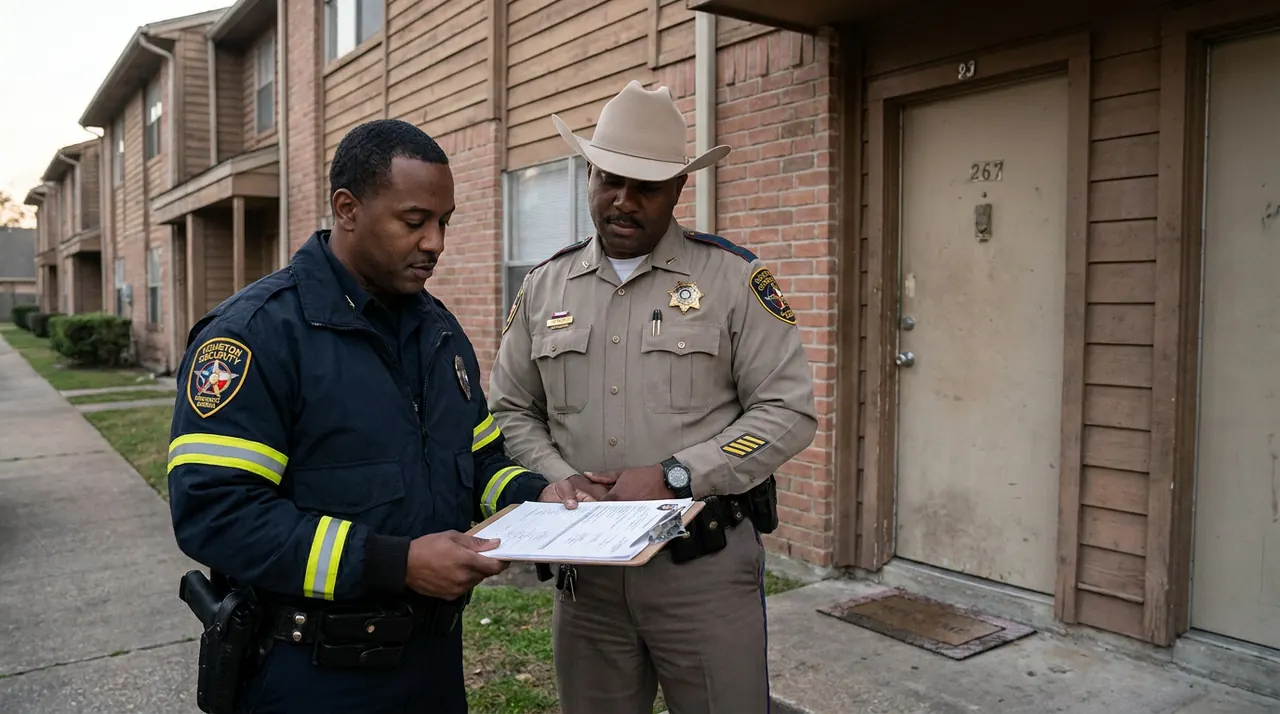
Eviction standby is the difference between that day and a day where nothing memorable happened. Our officer is on-site thirty minutes before the constable. The set-out crew works inside a secured perimeter. Onlookers are politely managed. Every minute is body-cam recorded so any later claim — missing property, damage, harassment — has video record. The unit is confirmed clear and secured at the end. The whole thing is over in 90 minutes, no story to tell, no police report, no resident complaints. That’s what good eviction standby looks like.
Standby is a discrete service per writ — or built into a retainer for properties running 5+ evictions a month.
Property manager sends writ details. We assign officer, confirm constable time, brief set-out vendor, run threat assessment on the tenant’s file.
Officer on-site, perimeter established, exterior unit condition photographed, set-out crew briefed in person.
Constable executes writ. Officer holds perimeter, manages onlookers, body-cam continuous. Constable’s authority leads — we follow.
Set-out complete. Unit empty. Locks changed. Documentation filed. Property manager receives full evidence package within 24 hours.
Standby is priced per writ execution — a flat fee per visit covering the officer’s pre-coordination, on-site time, set-out crew protection, and documentation. The base rate covers up to 2 hours on-site; extended writs (multi-bedroom units, large set-outs, complications) bill in 30-minute increments after that.
What shifts the rate: officer level required (Level II unarmed for routine writs; Level III armed for high-risk tenant files), multi-officer assignments (sometimes a second officer is warranted — large unit, multiple known associates, prior threats), and scheduled return visits for personal-property recovery windows. High-volume properties running 5+ writs per month qualify for a discounted retainer rate.
Every assessment is free. Quotes are property-specific. We’ll quote your typical writ rate and a per-event flat number against your actual eviction volume.
A landlord evicting a single-family rental has one tenant, one yard, and no audience. The set-out happens on the front lawn; the worst-case bystander is the next-door neighbor. A 240-unit apartment community evicting unit 312 has an audience of 800 people. Other residents are walking past the breezeway as the set-out crew carries furniture out. Phones are recording from every balcony. Social media gets the worst 12 seconds of the day, captioned with whatever the resident filmer thinks happened.
That changes the standby officer’s job entirely. Our officer manages the crowd — politely, respectfully, but firmly. We’ve done this hundreds of times at apartment communities. We know exactly which spot in the breezeway needs a body to stand there so residents redirect. We know which words to use with the curious neighbor who lives next door. We know when a resident’s sympathetic objection is worth listening to and when it’s engineered drama.
And we know the property side of the math. The evicted tenant is a single relationship that’s ending. The 239 other residents are relationships you need to preserve. Mishandle the eviction in front of them and you’ll spend 90 days defending it on Google reviews. That’s the multifamily-specific judgment that single-family or commercial standby firms simply don’t have.
No. Texas writ-of-possession evictions require a constable (or Harris County’s designated officer). We work alongside the constable, not in place of them. Our role is property safety, set-out crew protection, resident-witness management, and documentation — everything the constable doesn’t have time to handle.
Officer arrives 30 minutes before the scheduled writ execution. Coordinates with constable and your set-out crew. Provides body-cam documentation of the property condition before, during, and after. Manages neighboring residents who come to watch. Handles any contact from the evicted tenant. Confirms unit is clear and secured.
Level III armed officer assigned, advance threat assessment, and coordination with constable on tactical approach. We will also recommend HPD presence in extreme cases — that call comes from the constable’s office but we facilitate it through the proper channels.
Yes — this is actually where most of the value comes from. Set-out workers are exposed to verbal aggression, property damage, and occasionally physical threats from the evicted tenant or returning friends/family. Our officer keeps the perimeter secure so the crew can work. Crews that work with our standby tend to come back next time.
Texas writs typically allow a recovery window for personal property. We coordinate that meeting — scheduled appointment, officer present, body-cam recording, no surprise visits. After the legal window closes, the now-ex-tenant can be trespassed; see our trespasser-removal service for the longer-term enforcement.
With the dignity that the law requires and the property’s reputation demands. The eviction is happening; that decision has been made by a court. Our job is to ensure it happens safely and humanely. Aggressive or escalating behavior from our officers makes the situation worse — for everyone, including the property’s long-term reputation.
After the writ — the now-ex-tenant gets formally trespassed and removed if they return.
ExploreWatches for the evicted tenant returning during the 30-day "high-risk" window after move-out.
ExploreEvicted tenant’s fobs and credentials deactivated within 30 minutes of writ execution.
ExploreWe can staff most writs with 48 hours of notice. High-risk files we’ll plan around. Free assessment includes a review of your last 12 months of evictions and what went wrong.