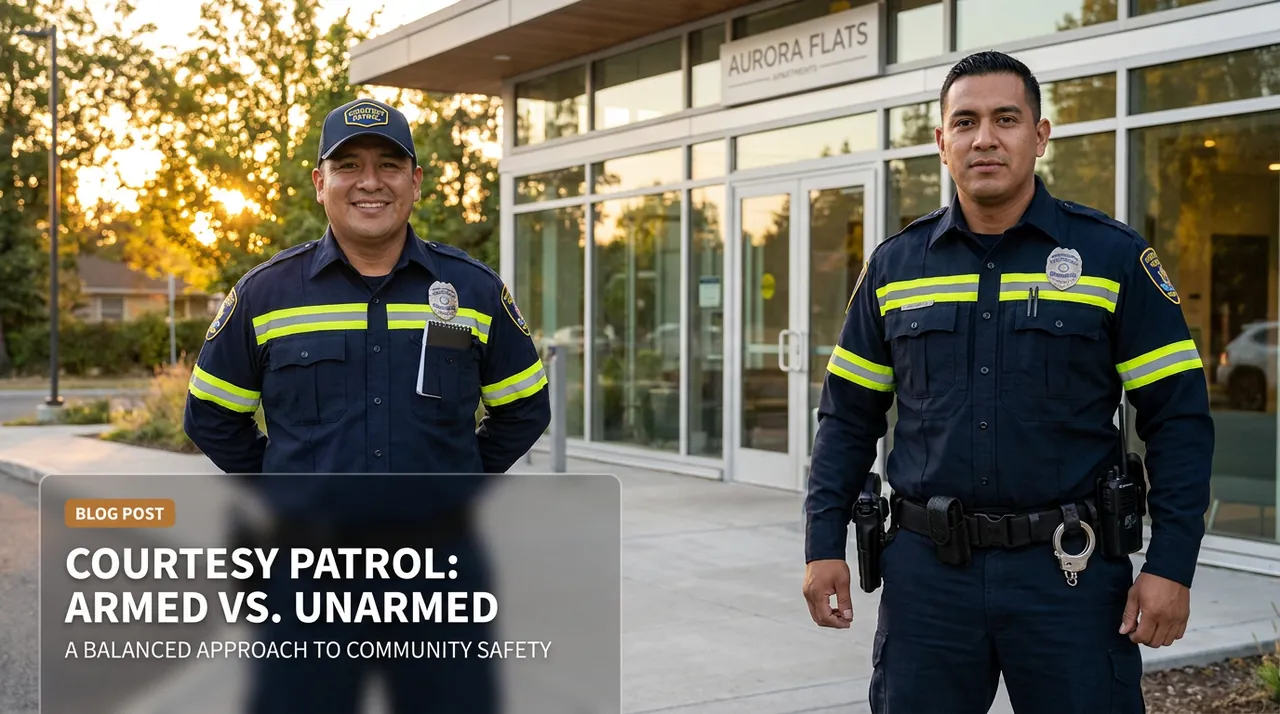
The first thing a property manager asks when they price out security is whether they need armed officers. The honest answer is “sometimes,” and the longer answer fills this article. Multifamily is not retail and is not a stadium. The wrong staffing model attracts liability without preventing incidents, and the right one quietly disappears into the background of a well-run community.
Houston security firm. Only multifamily. Nothing else. The frame matters because the armed-versus-unarmed conversation looks completely different on a 320-unit garden community than it does on a downtown retail concourse or a music venue. The same officer in a different uniform behaves differently. The same property with the wrong officer absorbs liability it did not earn. We will walk through how to think about the choice with multifamily-specific examples and the trade-offs we see day to day.
What courtesy patrol actually does
Before you can choose between armed and unarmed, you have to be honest about what courtesy patrol is and is not. Courtesy patrol is a visible, uniformed presence walking and driving a property on a published schedule. It is preventive, not reactive. The job is to be seen, to know residents, to spot anomalies, and to escalate situations that exceed the officer’s authority — which on multifamily is most of the situations worth escalating. A courtesy patrol officer is not a substitute for police. They are an early-warning, friction-introducing, log-keeping presence that prevents the small-stakes incidents from compounding into large-stakes ones.
That definition matters for the armed question because most of what courtesy patrol does — walking the perimeter, checking the pool gate, logging suspicious vehicles, watching the mail room at peak hours — is unchanged by whether the officer carries a firearm. The firearm only matters in the small fraction of encounters that escalate past verbal de-escalation, and in those encounters the question is whether the officer’s training matches the weapon they are carrying.
The honest comparison
| Factor | Unarmed | Armed |
|---|---|---|
| Deterrent value at the gate | Strong for opportunistic loiterers. Visible uniform and patrol vehicle still does most of the work. | Marginally higher only if the firearm is openly carried. Concealed carry adds no deterrent. |
| De-escalation outcomes | Officers are trained to leverage verbal skills because they cannot rely on force. Often better in resident-facing disputes. | Risk that a visible firearm raises the temperature of an otherwise verbal encounter. |
| Property-owner liability | Lower premium impact. Fewer exposure scenarios. | Higher premium. Discharge incidents create catastrophic-tier claims even when justified. |
| Hourly cost | Typically 25–40% lower than armed in our market. | Higher hourly rate plus higher insurance cost passed through. |
| Resident perception | Reads as “courtesy patrol.” Approachable. | Reads as “armed guard.” Some residents find reassuring, some find alarming. Demographic-dependent. |
| Best fit | Most Class A and Class B garden and mid-rise communities. | Properties with documented active-threat history, high-rise concierge desks, or specific risk profile. |
When unarmed is the right answer
For the majority of Houston multifamily properties we patrol, unarmed is the right choice. The reasons are not philosophical. They are operational.
First, the incidents we are actually called for on multifamily are heavily weighted toward what a professional security trainer would call “low-force” situations — trespassers in the pool, residents in dispute, a suspicious vehicle in visitor parking, a door propped open after midnight. None of these are resolved by drawing a firearm. They are resolved by a uniformed person asking calmly what is going on, listening, and either logging the situation or calling police.
Second, an unarmed officer who is well trained in de-escalation outperforms an armed officer who is not. The most consequential variable is not what the officer carries. It is how the officer talks to people in their first ninety seconds on scene. We invest heavily in de-escalation training for that reason.
Third, the insurance and liability story is dramatically simpler with unarmed patrol. The owner’s general liability premium does not absorb the same loading. Tenant counsel cannot reach for “the property knew the officer was armed” as part of an after-incident pleading. Calls about overall claim frequency tilt downward when communities switch from a non-specialist armed model to a specialist unarmed one with better training.
Across the Houston multifamily portfolio we patrol, roughly 9 out of 10 communities are best served by an unarmed model paired with strong dispatch escalation to local police. The 1 in 10 where armed is justified are nearly always identifiable up front by a specific risk profile, not by a generic “we just feel safer” preference.
When armed is the right answer
There are real cases where armed officers fit. Here are the patterns we look for:
- Documented violent-incident history. Not perception, not anecdote — police reports and resident complaints that point to a specific elevated threat. If your property has had multiple serious incidents in the trailing twelve months, the calculus shifts.
- High-rise concierge with controlled lobby access. Single point of entry, fixed post, predictable schedule. An armed concierge officer in this setting has a clear engagement zone and clear protocols.
- Adjacency to a known high-risk venue. A property that fences with a 24-hour bar, a high-crime corridor, or a known open-air drug market sometimes benefits from the visible-armed deterrent specifically at the boundary.
- Owner-mandated by lender or insurer. Some refinance or new-build covenants require armed security as a precondition. In those cases the choice is made above the property manager’s pay grade.
- Eviction or trespasser-removal standby. Specific, scheduled events with a known risk profile can warrant armed standby for that event without changing the regular patrol model. See our eviction standby service for how that works.
Outside these patterns, the argument for armed thins out quickly. “The market is changing” is not a reason. “Residents would feel safer” is sometimes true and sometimes the opposite — demographic surveys frequently show younger and family demographics react negatively to visibly armed presence.
What licensing actually requires in Texas
Texas regulates private security through the Department of Public Safety, Private Security Bureau. Unarmed officers hold a Level 2 (Non-Commissioned) license. Armed officers hold a Level 3 (Commissioned) license that adds firearm training and a separate continuing-education requirement. Properties contracting armed officers are entitled to ask for and verify the commissioning paperwork. We provide it on request before any officer steps onto a property, and we keep current copies on file with the property’s vendor records.
One distinction worth knowing: the difference between off-duty police and licensed armed security is not just a uniform change. Off-duty officers carry sworn authority and the corresponding indemnification rules. Licensed armed security does not. For multifamily, the cleaner model is licensed armed security under your vendor relationship, not informal off-duty arrangements that blur whose insurance answers when something goes wrong.
The hybrid model we recommend most often
The most common arrangement we deploy on Houston multifamily is unarmed continuous patrol with armed event-specific add-on. The continuous patrol uses unarmed officers around the clock or during whatever window the property staffs. The armed component appears only for scheduled, identifiable events:
- Eviction days, where the constable’s presence sets the legal baseline and our armed officer adds civilian-side standby.
- Major resident-removal or trespass actions on owners with a known elevated risk profile.
- Special property events — resident move-out spikes, holiday displays, model-unit opens — with a defined start and end time.
The hybrid model gives the property the deterrent benefit when it matters and the liability and cost discipline of unarmed for the other 95% of patrol hours. It also keeps the same uniformed faces on the property for continuity, which residents notice.
The cost conversation, honestly
Armed officers cost more per hour, and not by a token amount. In our market the spread runs roughly 25 to 40% above unarmed for comparable shift coverage. The insurance, training, and equipment burden is real and it is not where a vendor should be trying to win on price. If a competing bid offers armed coverage at unarmed rates, ask exactly which line items they cut to get there. Frequently the answer is training hours, supervision ratio, or insurance limits — none of which you want trimmed.
For most properties, the more interesting cost question is not armed-versus-unarmed but coverage hours. Cutting two armed shifts to fund continuous unarmed coverage is almost always the better trade. A property is not safer at 2 a.m. because an armed officer was there at 6 p.m. but is not there now.
How to think about your specific property
Three questions, in order. Answer them honestly, with documentation rather than gut feel.
- What has actually happened on the property in the last twelve months? Not perception. Police reports, resident complaints, incident reports from current vendor.
- What does the adjacency profile look like? What is on the other side of every fence and across every street?
- What is the demographic mix and what do residents expect? Survey your population if you do not know.
If the answers to those three point to elevated, specific, documented risk, an armed component fits. If they describe a typical Class A or Class B community with manageable adjacency and a mixed demographic, an unarmed continuous model with armed event add-ons is the better fit. The decision is property-specific, not vendor-specific. Beware any vendor that recommends the same model for every property — that tells you they are selling a product, not solving for your property.
A specialist multifamily security firm should be able to articulate which of your specific patrol hours benefit from armed and which do not. If the vendor proposal recommends a single staffing model for all of your hours without distinguishing daytime concierge, evening pool, overnight perimeter, and event-driven needs, the proposal is generic. Ask for a tiered model.
What we tell new clients on the first walkthrough
We bring no preference to the first conversation. The walk produces the recommendation. Most often it produces unarmed with surgical armed add-on. Occasionally it produces full-time armed at specific posts. Once in a long while it produces a recommendation to reduce existing armed coverage and reallocate the budget to camera or lighting fixes that the property was missing. The right answer is the one the property — not the vendor — needs.
Key takeaways
- For most Houston multifamily, unarmed continuous patrol with armed event-specific add-on is the right model.
- Armed makes sense when documented incident history, lender mandate, fixed concierge post, or high-risk adjacency justifies it — not because it “feels safer.”
- The most important officer variable is de-escalation training, not whether the officer is armed.
- Insurance and liability exposure is materially different between models. Premium loading is real.
- A specialist vendor recommends the model your property needs. A generalist recommends the model they sell.