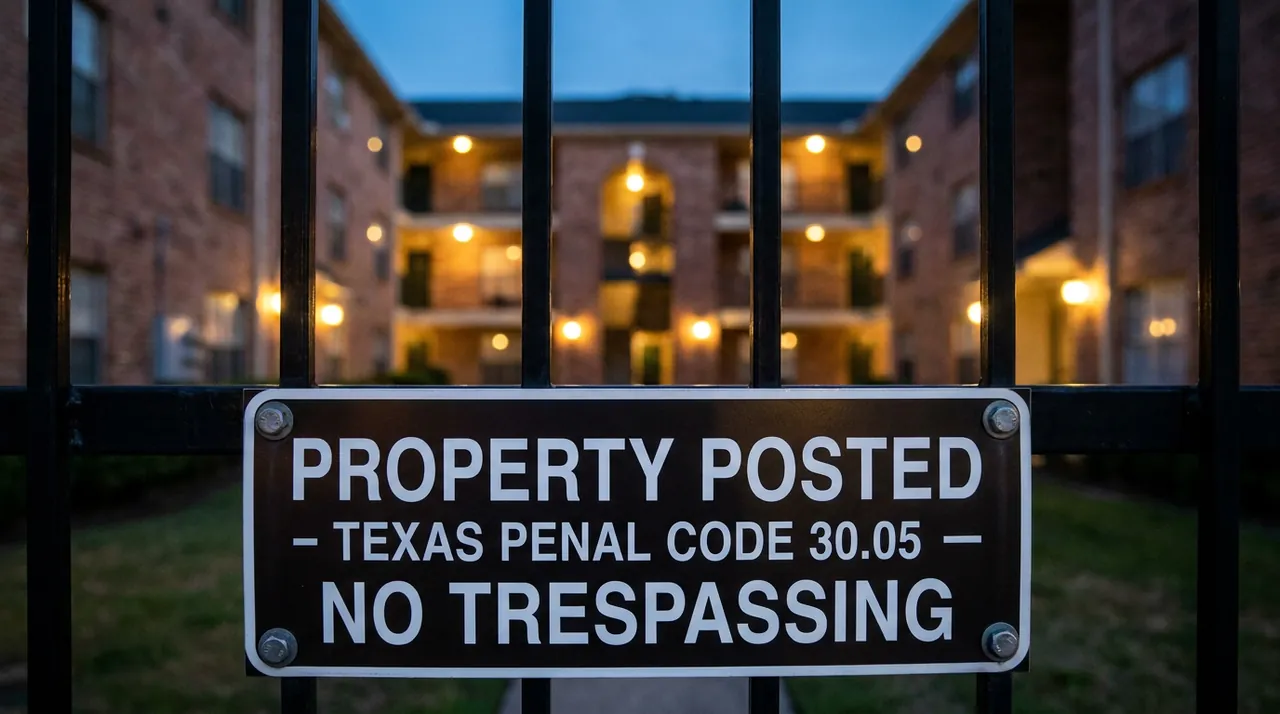
This article is general operational guidance for HOA and condominium boards, not legal advice. Boards should retain qualified Texas counsel before relying on anything below in a specific dispute. With that disclaimer attached, here is how the trespass statute actually operates on a multifamily property — and where most HOA policies quietly fail.
Houston security firm. Only multifamily. Nothing else. The reason that frame matters is that the trespass statute applies across every property type but plays out differently on multifamily because the property has residents, common areas, guests, contractors, and a long list of legitimate visitors. The same posting, warning, and removal procedures that suffice for a fenced industrial yard can leave a multifamily board exposed to liability, civil-rights claims, and unenforceable trespass warnings — sometimes all three from the same incident.
What Section 30.05 actually says
Texas Penal Code Section 30.05 makes criminal trespass an offense when a person enters or remains on property of another without effective consent and the person:
- had notice that entry was forbidden, or
- received notice to depart but failed to do so.
The statute defines “notice” by enumerating its forms: oral or written communication by the owner or someone with apparent authority; fencing or other enclosure obviously designed to exclude intruders; a sign or signs posted on the property reasonably likely to come to the attention of intruders, indicating that entry is forbidden; the placement of identifying purple paint marks on trees or posts; and visible presence of crops grown for human consumption. Two of those forms — signs and purple paint — matter most for multifamily. Boards focus too often on signage language and not often enough on whether the sign or the verbal warning was actually delivered to a specific person whose name and description are documented.
The statute also distinguishes levels of the offense. Ordinary criminal trespass is a Class B misdemeanor; trespass in a habitation, with deadly weapon, in a Superfund site, or in certain other circumstances is elevated. For multifamily, the “in a habitation” elevation matters — a trespasser inside a residential unit, breezeway, or interior common space is in a different legal category than one in an outdoor parking lot.
What boards owe owners and residents
A Texas HOA, condominium association, or apartment property owner has a duty to exercise reasonable care to keep common areas reasonably safe. That duty is not absolute, and it is not a guarantee against every possible incident. What it does require, on the trespass question specifically, is that the property:
- Posts notice that satisfies the “reasonably likely to come to the attention of intruders” standard.
- Maintains a documented process for issuing trespass warnings to specific individuals once they have been identified as not having consent.
- Communicates the trespass-warned list to whoever enforces it on the ground — patrol officers, leasing staff, or the police district when criminal trespass is reported.
- Does not enforce the policy in a discriminatory pattern that could trigger fair-housing claims.
- Does not exceed the statute’s authority — for example, by purporting to remove a resident’s actual guest with whom the resident has consent.
In our experience auditing multifamily trespass policies, the most common failure is not signage and not posting — it is the absence of a written, identifiable record of who has been trespass-warned, by whom, on what date, with what description. A property that cannot produce that list at the gate has effectively not warned anyone, no matter how many signs it has hung.
What “effective consent” means on a residential property
The statute hinges on consent. On an apartment community, consent is layered:
- The property owner has overall consent authority.
- The HOA or association, where applicable, has authority delegated by the governing documents.
- The management company, acting as agent, has apparent authority within its scope.
- Individual residents have authority to grant access to their guests and invitees within their leasehold or unit ownership.
- Vendors and contractors have authority only within the scope of the work they have been engaged to perform.
This layering matters because a person walking onto an apartment property is not automatically a trespasser if any of the above has granted consent. The visitor at the gate visiting Unit 312 has effective consent from the resident of Unit 312, even if the property would prefer they not be there. Trespass enforcement that tries to override resident-granted consent for ordinary guests collides with the resident’s leasehold rights and can produce civil liability for the property — even when the policy looks tidy on paper.
The exception is residents who themselves are subject to lease termination or eviction proceedings, and the rare case where a court order limits a resident’s ability to host specific named individuals. Those are real and they are enforceable, but they live in specific paperwork, not in “the courtesy patrol officer thought he didn’t belong here.”
Posting that actually meets the standard
Boards spend a lot of time arguing about sign language. The statute itself does not prescribe specific wording — only that the sign be “reasonably likely to come to the attention of intruders” and that it indicate “entry is forbidden.” What actually fails the standard in practice:
- Signs hidden in landscaping, behind hedges, faded past readability, or oriented toward the property interior rather than the street.
- Signs at only one entry on a property with multiple pedestrian and vehicle entrances.
- Signs in English only in a community whose population is substantially non-English-speaking. Bilingual posting is a best practice in Houston regardless of legal minimum.
- Signs that try to do too much — rule book, tow policy, hours, and trespass warning compressed into one cluttered sign that nobody reads. The trespass notice should be readable in two seconds from twenty feet.
- Signs that purport to authorize use of force beyond the statute’s reach. These do not increase the property’s rights and may damage them by signaling a posture a jury later finds unreasonable.
A simple, large, weather-resistant sign at every pedestrian and vehicle entry, stating clearly that the property is private and entry without consent is forbidden, plus the property’s name and twenty-four-hour contact number — that combination satisfies the statute and reads as a serious, well-run property to anyone considering whether to enter.
Issuing a trespass warning that holds up
A trespass warning is the moment the statute’s “notice to depart” or “notice that entry is forbidden” attaches to a specific individual. To hold up downstream, the warning needs:
- Identification of the warned individual. A photograph if possible, otherwise a written description including date of birth or age range, height, weight, race, sex, and any distinguishing marks. A name alone is not enough — many trespassers give false names.
- The date and time of the warning.
- The person issuing the warning. Property manager, on-duty officer, or the resident at whose request the warning was issued. Authority to warn flows from someone with apparent authority over the property — an officer alone may not be enough if challenged.
- The reason, briefly and factually. “Soliciting in unit hallways” or “refused to leave pool after closing.” Avoid characterization. Stick to observable behavior.
- The duration of the warning. Indefinite, one year, six months. Texas does not impose a maximum, but courts respond better to defined durations than to perpetual bans without review.
- Evidence of delivery. A signed acknowledgment if the individual signs; otherwise, photographic evidence of the verbal warning if circumstances allow; police report number if criminal trespass charges were filed at the moment of the warning.
A trespass-warning template that captures these elements turns an ad-hoc “he got run off the property” into a documented event that a future incident can build on. Most properties we audit do not have this template. We provide ours during the free assessment.
Properties that maintain a current, written trespass list and properties that do not look identical from the curb. The difference appears only after an incident, when the property is asked to prove that a specific individual had been warned. The first kind of property can answer. The second kind cannot.
Where multifamily policies fail in practice
Selective enforcement
A property that issues trespass warnings to some demographic groups and not others will eventually face a fair-housing complaint, and possibly a Department of Justice or HUD action. Selective enforcement does not have to be intentional to be discriminatory in effect. The defense is consistent, documented application of the same policy to every individual whose behavior crosses the same threshold. The list and the policy that produces the list are what answer the “why this person, why not that person” question.
Conflating trespass with eviction
Trespass enforcement does not substitute for eviction proceedings. A resident in default on rent or violating a lease term is not a trespasser. Treating them as one bypasses the statutory eviction process and produces wrongful-eviction exposure. The cleaner path is to pursue eviction, and to use trespass enforcement only against true non-residents and against former residents after the eviction is fully completed and any post-eviction window has expired.
Verbal-only warnings
The statute permits verbal warnings, and they are often the first warning issued. The failure is to treat them as the only warning issued. A verbal warning that is not documented in writing the same shift it occurred has only the memory of the officer to support it. Six months later, that memory is fuzzy. Document at the time, every time.
No process for resident-requested warnings
Residents frequently want a former partner, neighbor, or family member trespass-warned from the property. Their request alone is not authority for a property-wide warning — the resident generally cannot ban someone from another resident’s home. But the property can warn specific named individuals from common areas, and can support a resident’s protective order with logistical cooperation. The property needs a workflow for evaluating these requests, not an ad-hoc decision at the desk.
No coordination with the local police district
A trespass warning that has not been shared with the local police district is operationally weaker. The district will respond to a criminal-trespass call, but officers on the scene cannot independently verify a warning unless the property has registered the list or can produce documentation on the spot. Many Houston-area districts will accept a current trespass list as part of a routine community-liaison meeting.
Removing a trespasser, safely
The removal step is where most physical risk lives. Patrol officers, leasing staff, and residents are not police officers and should not behave as if they are. Practical guidance we train our officers on:
- Issue the warning first, verbally and clearly. Provide an opportunity for voluntary departure. Most trespassers leave when they understand the consequence.
- If the individual refuses or escalates, disengage and call police. The property’s job at that point is documentation, not physical removal.
- Do not use force except as a last resort to defend self or others. The Texas statute on defensive force is narrow; the civil liability for misuse is broad.
- Document the encounter immediately. Officer notes, photographs, body-worn or vehicle camera footage if available, and any witness statements.
For properties with recurring removal needs, a dedicated trespasser-removal program with patrol officers who know the trespass-warned list and have built relationships with the district works better than ad-hoc calls.
The HOA versus apartment-owner distinction
A condominium HOA enforcing trespass on the association’s common areas has a slightly different posture than an apartment owner enforcing trespass on the entire property. The HOA must work within the governing documents and any state-law overlay (Chapter 82 of the Texas Property Code for newer condominiums, Chapter 81 for older). The apartment owner has more unilateral authority but is subject to fair-housing and lease-implication constraints.
For mixed properties — an HOA with rental units, or a condominium with rented units — both layers apply. Counsel familiar with both regimes is the right resource. We are not that resource. We are the firm that helps you operate the policy on the ground once counsel has shaped it.
What good policy looks like, end to end
- Counsel-reviewed trespass-warning policy adopted by the board or owner.
- Adequate signage at every pedestrian and vehicle entry, bilingual where appropriate, weather-resistant, well-maintained.
- Written trespass-warning template that captures identification, date, issuer, reason, duration, and delivery evidence.
- Centralized trespass-warned list, kept current, accessible to whoever enforces it on the ground.
- Consistent enforcement across all demographic groups, demonstrable from the list and the underlying behaviors logged.
- Documented coordination with the local police district, including periodic sharing of the list.
- Removal protocols that prioritize de-escalation, defer physical force to police, and document every encounter.
- Annual policy review by counsel and an operational review by the security vendor.
Key takeaways
- Texas Penal Code 30.05 turns on consent, notice, and refusal to depart. Each piece must be present and documented for an enforcement action to hold.
- Posting is necessary but not sufficient. The trespass-warned list, kept current and in writing, is where most multifamily policies fail.
- Effective consent on multifamily is layered — owner, association, management, resident, vendor. Trespass policy must respect resident-granted consent for ordinary guests.
- Selective enforcement is a fair-housing risk even when unintentional. Consistent application is the defense.
- Trespass enforcement is not a substitute for eviction. Treating it as one creates wrongful-eviction exposure.
- The removal step belongs to police when an individual refuses. Property staff and patrol document and disengage.