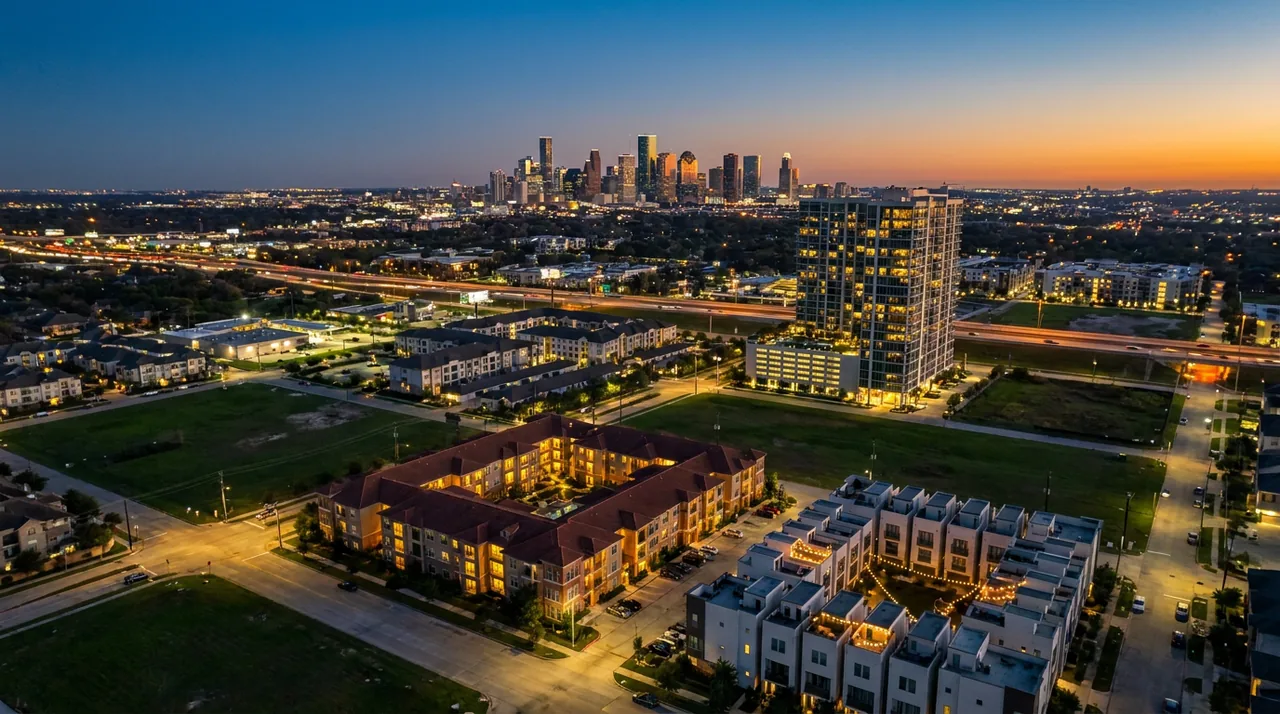
Before we say anything about numbers, two ground rules. First, all of what follows is observational data from the apartment communities we patrol — not a peer-reviewed study, not a city-published statistic, not a Uniform Crime Reporting summary. We are honest about the sample and we will not invent precision we do not have. Second, when we describe what we see, we use ranges and field observations rather than fake decimal points. A property manager who needs three-significant-digit precision should pull NIBRS data from the Texas Department of Public Safety or, for the City of Houston, the Houston Police Department public crime statistics portal.
With that out of the way: Houston security firm. Only multifamily. Nothing else. Eleven years of patrolling apartment communities across twelve cities in the Houston metro gives us a useful pattern view of what is happening on multifamily specifically, separate from what is happening on retail or industrial parcels. The two pictures are not the same. A patrol team that runs both will tell you they look different. We only run multifamily, so what follows is multifamily-shaped.
The categories we actually see, in rough order of frequency
Across the multifamily portfolio we patrol, the incident mix we encounter on a typical month looks like this, in descending order:
- Vehicle burglary and vehicle property theft — by a wide margin the most common multifamily incident type.
- Package theft from common-area parcel rooms, hallways, and unit doorways.
- Trespass and loitering in pool decks, breezeways, and stairwells after hours.
- Resident disputes and noise calls that escalate from a property-management issue into a patrol-response event.
- Mailbox tampering and mail theft, often clustered in two or three days in a row when a specific actor sweeps a cluster of properties.
- Domestic-violence calls involving residents or their guests.
- Auto theft (the vehicle itself, not its contents) — lower in frequency than vehicle burglary but higher in dollar value per incident.
- Burglary of habitation — entry into an occupied or unoccupied unit. Lower frequency than the above but higher consequence.
- Aggravated assault, robbery, sexual assault — rare on the typical multifamily property, but the events that drive the most resident concern and the most media attention when they do occur.
The shape of the list matters more than absolute counts. A property manager spending most of their security thinking on item 9 while doing nothing different about items 1, 2, and 3 is mis-allocating attention. The high-consequence events get the headlines. The high-frequency events drive the resident’s lived experience of safety.
If you asked a resident on a typical Houston apartment property what makes them feel safe or unsafe, you would hear about parking-lot break-ins, package theft, and people they did not recognize in the breezeway — not about violent crime statistics. Security spend that lowers the first three lifts renewal numbers. Security spend that only addresses the last category may not move the renewal needle even when it is doing the right thing on absolute risk.
What we see by sub-market
Twelve cities is too few for statistical precision, but enough for honest qualitative observation. The summary below is what our patrol officers report and what our supervisors see when they audit the incident logs. Treat each entry as a tendency, not a forecast. Adjacency, property class, and management quality routinely produce communities in “low-incident” cities that have more issues than communities in “higher-incident” cities. The street matters more than the city.
| Sub-market | What we tend to see on multifamily |
|---|---|
| Inner-loop Houston | High pedestrian traffic, high mix of retail-adjacent communities. Vehicle burglary clusters, periodic trespass from foot traffic. Higher Class A density. |
| Galleria / Uptown | Mid-rise and high-rise multifamily with concierge models. Package theft and vehicle burglary are the dominant patterns. Lower trespass on properties with controlled lobby. |
| Greater Heights / Midtown | Mixed-use frequently has retail downstairs and residential upstairs. Crowding at amenities and after-hours pool trespass are common operational items. |
| Southwest Houston | Older Class B and C garden communities. Adjacency matters more here than elsewhere — the same street can run two communities with very different incident profiles. |
| Katy | Newer garden and three-story communities. Vehicle burglary and package theft dominate. Lower trespass than inner-loop. Katy multifamily security. |
| Sugar Land | Mostly Class A and B with strong management. Pool-trespass and after-hours amenity issues outweigh property crime in most cases. Sugar Land multifamily security. |
| Pearland | Newer construction, lower density. Vehicle burglary is the dominant pattern; trespass and loitering are less frequent. Pearland multifamily security. |
| The Woodlands | Mostly Class A with active management. Patrol calls weight toward resident-dispute mediation and amenity policy enforcement. The Woodlands multifamily security. |
| Spring | Mix of older and newer. Adjacency to commercial corridors drives most variation. Vehicle break-in clusters when freeway access is near. |
| Cypress | Newer suburban communities. Lower-frequency patterns but periodic auto-theft spikes that move through clusters of properties on the same week. |
| Humble / Atascocita | Mixed property classes. Vehicle burglary dominates. Trespass concentrated near retail adjacency. |
| Bellaire / West U | Higher-value vehicles in lots means higher dollar exposure per vehicle break-in. Lower volume but higher consequence per event. |
The four patterns we expect to persist through 2026
1. Vehicle property theft remains the dominant multifamily incident type
Across every sub-market and every property class, vehicle burglary is the highest-frequency category. The patterns are operationally consistent: actors work clusters of cars in a single visit, target visible items in the cabin and items under spare-tire covers in SUVs, and disproportionately hit cars left unlocked. Surveillance camera coverage of parking aisles plus a continuous patrol presence during the late-evening to early-morning hours moves this number more than any other intervention.
2. Package theft will continue to scale with e-commerce volume
Properties without controlled package rooms or smart-locker programs will see package theft frequency rise as a function of how much volume their residents receive. Properties with locker programs see a step-change reduction. The locker installation pays back in resident-satisfaction metrics faster than in pure incident reduction.
3. After-hours pool and amenity trespass remains a top complaint source
Independent of crime trends, the resident-complaint volume on after-hours amenity use stays high. The driver is not crime, it is noise, mess, and the perception that the rule is unenforced. A visible patrol pattern that hits the pool, fitness center, and common areas at posted closing time moves resident satisfaction even when no enforcement actually occurs.
4. Mail theft moves in concentrated bursts
Mail-theft actors typically work a cluster of properties over a small number of days, then disappear. The mail-theft volume on any single property looks low until it spikes. Awareness of the regional pattern matters — we share alerts across the properties we patrol so that a hit on Tuesday in one part of town prompts increased vigilance on the same evening across nearby properties.
For statistically rigorous data, pull NIBRS submissions from the Texas Department of Public Safety, the Houston Police Department’s public crime statistics portal, and HUD’s multifamily-specific surveys. Cross-reference with the property’s own incident log over a 12-month window. The combination is more useful than any single source.
What “trends” actually mean for a single property
Metro-level trend conversations are useful for board presentations and budget defense. They are less useful for daily operations. For a single property, the operational metrics that matter are:
- Trailing-12-month incident counts by category, on this property specifically.
- Quarter-over-quarter movement on the top three categories.
- Geographic clusters on the property (which row, which building, which time of day).
- Comparison against the property’s own prior-year baseline, not against a metro average.
A property that benchmarks against a metro average will find itself either complacent (because it looks “better than average”) or alarmed (because it looks “worse than average”), and in both cases will be looking at the wrong reference point. The right reference point is the property’s own history. If vehicle burglary fell 30% on this property year over year, that is the news. The metro average is context.
What moves the numbers
From the property’s perspective, the interventions that move the dominant categories — vehicle property theft, package theft, after-hours trespass — are well known and operationally available:
- Continuous patrol presence during peak-incident windows. Most vehicle burglary on the properties we patrol happens between 11 p.m. and 5 a.m. Coverage during that window matters more than coverage during the afternoon.
- Lighting uniformity. Specifically, eliminating dark corners and dark aisles in parking lots. Lighting that varies dramatically across the lot tells actors which aisles to work first.
- Camera placement and recording quality. See our CCTV best practices post for the angles that matter.
- Package management. Locker programs, controlled package rooms, or staffed leasing-office pickup all reduce theft frequency.
- Resident communication. A property whose residents lock cars, do not leave packages on doorsteps, and report suspicious activity sees fewer incidents than a property whose residents do not.
- Trespass-warning workflow. Documented, enforced consistently. See our post on trespass and Texas Penal Code 30.05.
None of these interventions are exotic. The discipline is in doing them consistently and continuing to do them after the initial enthusiasm wears off. Most of the “crime trend” gap between communities in the same sub-market is not about the sub-market — it is about which property kept doing the basics.
What we tell new clients during the first assessment
The first question we ask on a new property assessment is for the property’s own incident log for the last twelve months. The second question is for the same data from the prior twelve months for comparison. If the property does not keep a log, we start there. A patrol vendor cannot move numbers that nobody is counting. Once the log is in place, the quarterly review and the year-over-year comparison drive the conversation.
Key takeaways
- Vehicle burglary, package theft, and after-hours trespass are the dominant multifamily incident categories across the Houston metro — not the higher-profile violent crime categories.
- Adjacency matters more than city. The same metro market contains communities with very different incident profiles based on what is across the street.
- The right reference point for a single property is its own prior-year baseline, not a metro average.
- The interventions that move the dominant categories are well known and operationally available. The differentiator is consistency, not innovation.
- For harder numbers, supplement field observation with NIBRS data, HPD’s public crime statistics, and the property’s own incident log.